

Custom WAF Rules
Aegis supports three rule match modes: Condition Builder for structured field/operator/value rules, Raw Regex for advanced RE2-based pattern matching, and Correlated for multi-request Mnemos correlation rules.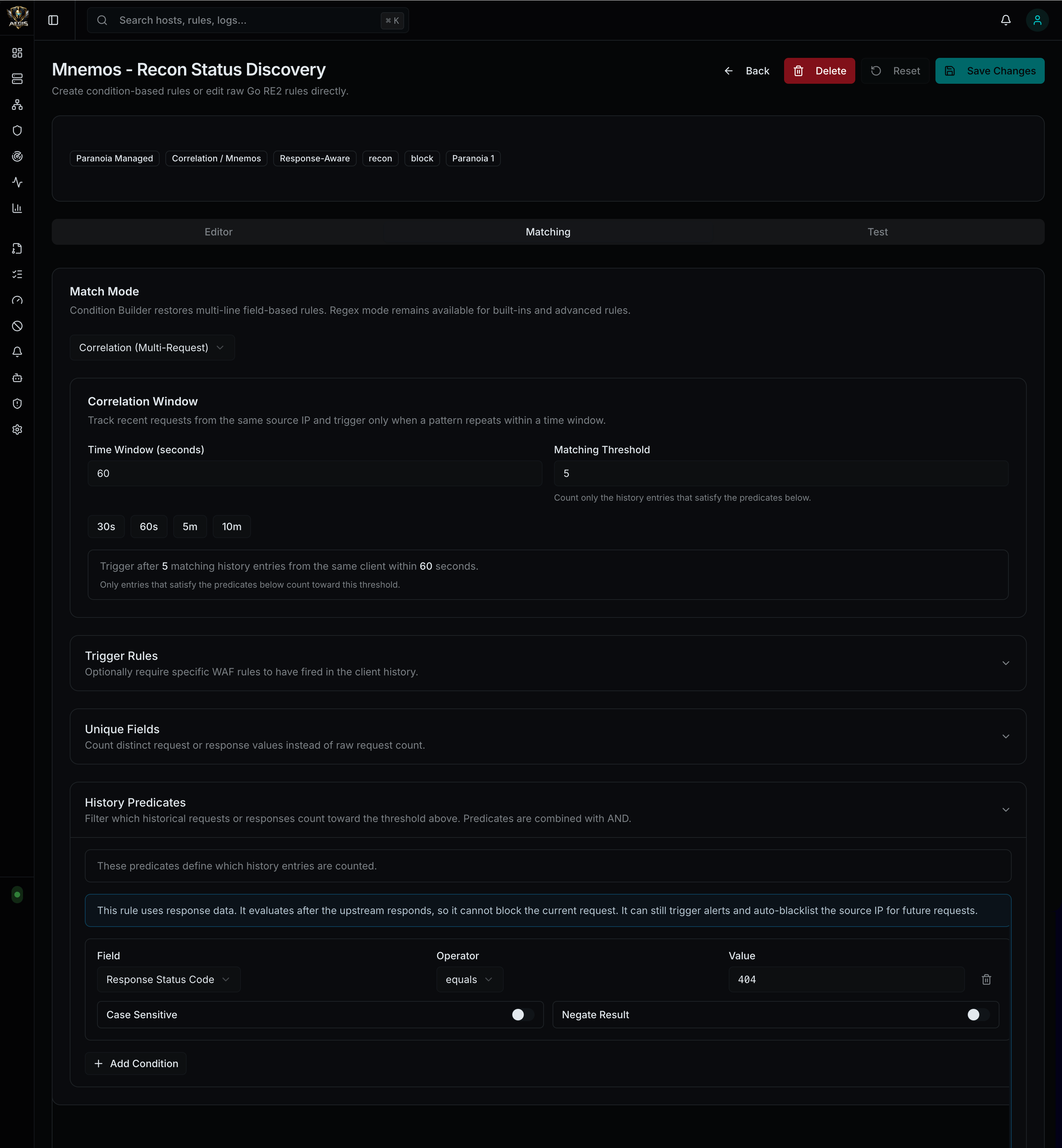
Rule Options
Every custom rule supports the following configuration:| Option | Description |
|---|---|
| Name | Rule display name |
| Description | Detailed description of what the rule detects |
| Category | Classification category |
| Severity | low, medium, high, or critical |
| Action | block, allow, challenge, log, or redirect |
| Enabled | Toggle rule on/off |
| Paranoia | Paranoia level (1-4) |
| Tags | Free-form tags for organization |
| OWASP IDs | Associated OWASP identifiers |
| CVE IDs | Associated CVE identifiers |
Condition Builder Mode
Condition Builder is the standard rule-authoring flow. It supports multi-line field-based rules withAND / OR logic.
Available Fields
| Field | Description |
|---|---|
| Request URI | Full request URI |
| Request Path | URL path component |
| Query String | URL query string |
| HTTP Method | Request method (GET, POST, etc.) |
| Request Body | Request body content |
| User Agent | User-Agent header value |
| Host Header | Host header value |
| Content-Type | Content-Type header value |
| Referer | Referer header value |
| Source IP | Client source IP address |
| Any Header | Match against any request header |
| Specific Header | Match against a named header |
| Any Cookie | Match against any cookie |
| Specific Cookie | Match against a named cookie |
Available Operators
| Operator | Description |
|---|---|
contains | Field contains the value |
does not contain | Field does not contain the value |
equals | Exact match |
does not equal | Not an exact match |
starts with | Field starts with the value |
ends with | Field ends with the value |
matches regex | RE2 regex match |
does not match regex | RE2 regex non-match |
is in list | Value is in a provided list |
is not in list | Value is not in a provided list |
greater than | Numeric comparison |
less than | Numeric comparison |
exists | Field is present (no value needed) |
does not exist | Field is absent (no value needed) |
is IP in range | IP or CIDR range match |
Per-Condition Options
- Case Sensitive — toggle case sensitivity
- Negate Result — invert the condition match
Examples
- Block requests where
Request Pathcontains/wp-admin - Block requests where
Specific Headermatches regexa malicious header pattern - Allow requests where
Source IPis IP in range10.0.0.0/8
Raw Regex Mode
Raw Regex mode is for advanced rules and built-in style pattern matching. You provide a Go RE2 pattern and one or more request targets to inspect.Supported Targets
| Target | Description |
|---|---|
| Path / URI | Request path and URI |
| Query String | URL query parameters |
| Body | Request body |
| Headers | All request headers |
| Cookies | All cookies |
| User Agent | User-Agent header |
Notes
- Patterns are compiled with Go’s
regexpengine (RE2 syntax) - Inline flags such as
(?i)are supported (server-side evaluation) - Rules require both a pattern and at least one target
Rule Testing
The rule tester uses the real backend WAF evaluation path — the same compiled Go regex engine and condition evaluator that runs in production. This is not a browser-side JavaScript approximation.Single Rule Test
Test an individual rule against a crafted request:| Field | Description |
|---|---|
matched | Whether the rule fired on the test request |
matched_target | Which request surface matched (path, query, body, headers, cookies, user-agent) |
matched_value | The specific value that triggered the match |
pattern_valid | Whether the regex compiled successfully (RE2 syntax) |
pattern_error | Compilation error message if the pattern is invalid |
processing_us | Evaluation time in microseconds |
Test All Rules
Test a crafted request against all enabled WAF rules to see which ones fire:Testing Correlation Rules
Correlated (Mnemos) rules can be tested by providing an array of requests that simulate a multi-request sequence:What Gets Tested
| Rule Mode | Evaluation |
|---|---|
| Regex | Pattern compiled with Go RE2, tested against selected targets |
| Conditions | Each condition evaluated with the same field extraction and operator logic as production |
| Correlated | Request sequence fed into a real correlation store with compiled host rules |
engine.TestRule() and engine.Evaluate() — so test results accurately predict production behavior.
Rule Import (JSON / YAML)
Aegis supports bulk importing WAF rules from JSON or YAML files via the admin API. This allows you to share rule sets between Aegis instances, version-control your custom rules, or ingest community rule definitions.Endpoint
.json, .yaml, or .yml file (max 4 MB). The format is auto-detected from the file extension.
File Format
Rules can be provided in either a wrapped or direct array format: Wrapped format (JSON):Import Behavior
- IDs are reset — imported rules receive new IDs; existing rules are not overwritten
- Host ID is cleared — all imported rules become global (not host-specific)
- Defaults applied — missing fields are normalized:
- Category defaults to
custom - Severity defaults to
medium - Action defaults to
block - Paranoia defaults to
1 - Regex rules with no targets default to
path,query,body,headers
- Category defaults to
- Validation — each rule is validated through the same logic used by the UI (regex compilation, condition field/operator checks, etc.)
- Proxy reload — after import, the proxy manager reloads all rule chains
Rule Schema Reference
| Field | Type | Description |
|---|---|---|
name | string | Rule display name (required) |
description | string | Detailed description |
category | string | Classification (e.g., sqli, xss, custom) |
severity | string | low, medium, high, or critical |
action | string | block, allow, challenge, log, or redirect |
enabled | boolean | Whether the rule is active |
paranoia | integer | Paranoia level (1-4) |
match_mode | string | conditions, regex, or correlated |
correlation_config | object | Correlation configuration (for correlated mode — see Mnemos) |
condition_logic | string | AND or OR (for condition mode) |
conditions | array | List of condition objects (for condition mode) |
pattern | string | RE2 regex pattern (for regex mode) |
targets | array | Request surfaces to inspect (for regex mode) |
tags | array | Free-form string tags |
owasp_ids | array | Associated OWASP identifiers |
cve_ids | array | Associated CVE identifiers |
Condition Object Schema
| Field | Type | Description |
|---|---|---|
field | string | Request field to inspect |
operator | string | Comparison operator |
value | string | Value to compare against |
case_sensitive | boolean | Enable case-sensitive matching |
negated | boolean | Invert the condition result |
Bundled Rule Sets
Aegis ships with importable rule sets in therules/ directory. These can be imported via the admin API or loaded from the CLI.
PayloadsAllTheThings Rule Set
Thepayloads-all-the-things.yaml rule set provides 35 detection rules derived from the PayloadsAllTheThings repository. It covers attack categories beyond the 26 built-in rules, including:
| Category | Rules | Coverage |
|---|---|---|
| SQL Injection | 5 | Auth bypass, time-based blind, error-based extraction, polyglots, stacked queries |
| NoSQL Injection | 2 | MongoDB operator injection, server-side JavaScript injection |
| Command Injection | 3 | Shellshock, newline injection, backtick/subshell execution |
| XXE Injection | 3 | Entity declaration, Billion Laughs, XInclude |
| GraphQL | 2 | Introspection probing, batching attacks |
| Server Side Includes | 2 | SSI directives, Edge Side Includes (ESI) |
| XSLT Injection | 1 | XSLT code execution and information disclosure |
| File Inclusion | 2 | Remote file inclusion, PHP wrapper exploitation |
| Open Redirect | 1 | Parameter-based redirect manipulation |
| Request Smuggling | 1 | Transfer-Encoding desync |
| CSV Injection | 1 | Spreadsheet formula injection |
| SAML Injection | 1 | Signature stripping and wrapping |
| JWT Attacks | 1 | Algorithm confusion (alg: none, key confusion) |
| Prototype Pollution | 1 | proto and constructor.prototype manipulation |
| Web Cache Deception | 1 | Static extension appended to dynamic paths |
| HTTP Parameter Pollution | 1 | Duplicate parameter injection |
| File Upload | 1 | Dangerous extension and null byte injection |
| LaTeX Injection | 1 | File read and command execution via LaTeX |
| Prompt Injection | 1 | LLM instruction override and jailbreak |
| Spring Boot Actuator | 1 | Exposed management endpoints |
| CSS Injection | 1 | Attribute selector exfiltration |
| Source Code Exposure | 1 | .git, .svn, .hg directory access |
| OAuth | 1 | Redirect URI manipulation |
| LDAP (Extended) | 1 | Blind LDAP and attribute extraction |
| DNS Rebinding | 1 | Known rebinding service domains |
| Type Juggling | 1 | PHP loose comparison bypass |
| Race Condition | 1 | Last-byte sync headers |
| WebSocket | 1 | Cross-site WebSocket hijacking |
| IDOR | 1 | Sequential ID enumeration patterns |
| Dependency Confusion | 1 | Internal package name probing |
- Recon to Exploitation Campaign — introspection/actuator probing followed by active injection
- Multi-Vector Injection Campaign — 4+ distinct injection techniques from the same client in 3 minutes
- Auth Attack Campaign — JWT, SAML, OAuth, and type juggling attacks correlated within 5 minutes
Mnemos OOB SQLi and Exfiltration Rule Set
Themnemos-oob-sqli-and-exfil.yaml rule set provides detection chains for:
- Out-of-Band SQL Injection — OOB function primitives + DNS/UNC exfil, correlated by Mnemos
- Data Exfiltration Campaigns — sensitive endpoint access + bulk extraction + schema recon, correlated by Mnemos